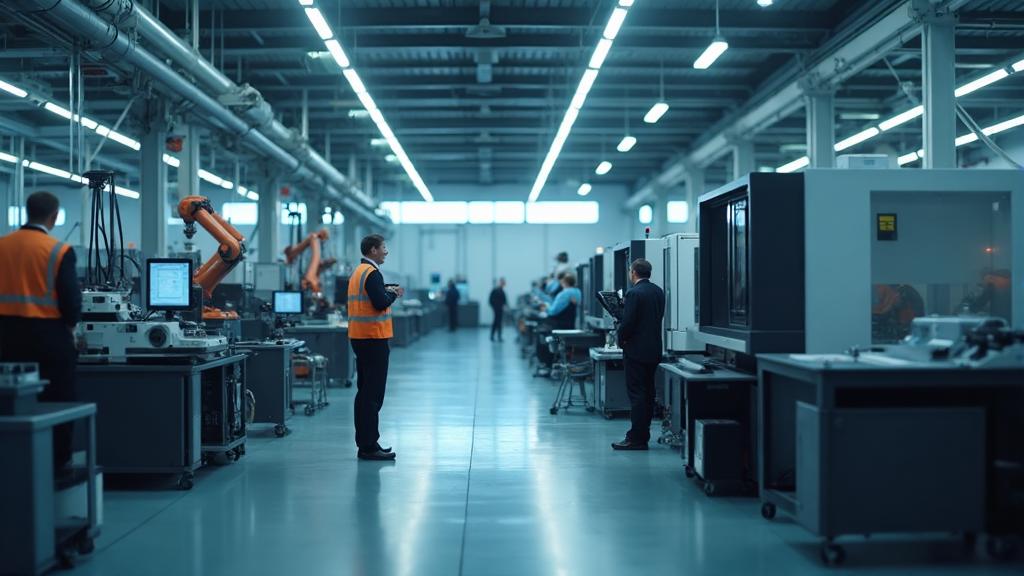
The Southeast manufacturing corridor—from Huntsville, Alabama through Chattanooga and Nashville, Tennessee to Atlanta and Savannah, Georgia—represents one of the most concentrated industrial regions in the United States. Automotive suppliers, aerospace manufacturers, food processors, chemical producers, and metal fabricators all operate within this corridor, each depending on increasingly interconnected technology systems to maintain production.
The IT/OT Convergence Challenge
Modern manufacturing facilities operate two distinct but increasingly interconnected technology environments: Information Technology (IT) and Operational Technology (OT). IT encompasses the business systems—ERP, email, file servers, and corporate networks. OT encompasses the production systems—PLCs (Programmable Logic Controllers), SCADA (Supervisory Control and Data Acquisition), HMIs (Human-Machine Interfaces), and industrial IoT sensors.
Historically, these environments were air-gapped—physically separated with no network connectivity between them. But the demands of Industry 4.0, real-time production monitoring, predictive maintenance, and supply chain integration have forced IT and OT networks closer together. This convergence creates enormous efficiency gains but also introduces significant cybersecurity risks.
A ransomware attack that penetrates the corporate email system can now potentially reach the factory floor. An unsecured IoT sensor providing temperature data to a cloud analytics platform can become an entry point for attackers targeting production systems. A compromised vendor VPN connection can give adversaries direct access to PLCs that control critical manufacturing processes.
Core12 specializes in managing this convergence securely for Southeast manufacturers.
Securing Operational Technology
Securing OT environments requires fundamentally different approaches than IT security. Production systems have unique constraints: they cannot tolerate the latency introduced by traditional security tools, they often run legacy operating systems that cannot be patched, and they must maintain 100% availability—a security update that requires a reboot could halt a production line worth thousands of dollars per minute.
Core12 addresses OT security through multiple layers:
Network Segmentation: We implement industrial DMZs (Demilitarized Zones) that create controlled boundaries between IT and OT networks. Traffic between zones passes through industrial-grade firewalls that understand OT protocols—Modbus, EtherNet/IP, PROFINET, OPC-UA—and can detect anomalous commands that indicate a cyber intrusion.
Passive Monitoring: Unlike IT environments where active scanning is standard practice, OT networks require passive monitoring that observes traffic patterns without introducing packets that could disrupt sensitive control systems. Core12 deploys OT-specific monitoring tools that create baseline behavior profiles for every device on the factory network and alert on deviations.
Legacy System Protection: Many Southeast manufacturing plants run PLCs and SCADA systems that are 15-20 years old. These systems cannot run modern endpoint protection, cannot be patched, and often communicate using unencrypted protocols. Core12 wraps these legacy systems in protective boundaries—network segmentation, protocol-aware firewalls, and access control lists—that limit exposure without requiring changes to the systems themselves.
IoT Integration and Security
The Industrial Internet of Things (IIoT) promises transformative benefits for manufacturers: real-time equipment monitoring, predictive maintenance, energy optimization, and quality control automation. But every IoT sensor, gateway, and cloud connection expands the attack surface.
Core12 manages IoT deployment for Southeast manufacturers with a security-first methodology:
Device Authentication: Every IoT device must authenticate before joining the network. We implement certificate-based authentication that prevents unauthorized devices from connecting to production systems.
Data Flow Control: IoT sensors should transmit data out of the OT network to analytics platforms—they should never accept commands from external sources. Core12 configures unidirectional data flows that allow monitoring without creating inbound attack vectors.
Firmware Management: IoT devices require regular firmware updates to address security vulnerabilities. Core12 manages firmware update schedules that ensure devices remain patched without disrupting production—coordinating updates with planned maintenance windows.
Critical Production Down Response
When a production line stops due to a technology failure, the financial impact is immediate and severe. A mid-market manufacturer running three shifts can lose $10,000-50,000 per hour of unplanned downtime, depending on the product and market.
Core12's Critical Production Down response protocol is designed for this reality:
Sub-10-Minute Human Response: When a manufacturing client reports a production-impacting issue, our system bypasses standard support queues and connects directly to engineers with OT experience. No chatbots, no tier-1 triage—immediate access to someone who understands industrial systems.
On-Site Monitoring Agents: We deploy monitoring infrastructure directly within manufacturing facilities that provides real-time visibility into both IT and OT systems. These agents can detect failing hardware, degrading network performance, and anomalous system behavior before they cause line stoppages.
Predictive Intervention: Our Managed Intelligence approach uses historical data to predict failures before they occur. If a network switch serving a critical production area shows increasing error rates, we replace it during a scheduled maintenance window—not after it fails during peak production.
Regional Manufacturing Expertise
The Southeast manufacturing corridor faces challenges that national IT providers often misunderstand. Multi-state operations require navigating different regulatory environments. Rural plant locations in Alabama and Tennessee may have limited internet connectivity options. The defense industrial base presence in Huntsville and Marietta introduces CMMC compliance requirements. Seasonal production fluctuations in food processing and agriculture demand flexible IT capacity.
Core12 operates from Atlanta with deep experience across the Southeast manufacturing landscape. We understand the ERP platforms these manufacturers run (SAP, Oracle, Epicor, Infor), the industrial networking protocols their production systems use, and the compliance frameworks their contracts require.
Our team has hands-on experience with the operational realities of manufacturing IT—from managing systems in non-climate-controlled plant environments to coordinating IT maintenance with production schedules that run 24/7.
Building Resilient Manufacturing IT
The manufacturers who will thrive in the Southeast corridor are those who treat IT and OT security as a unified discipline, who integrate IoT strategically rather than indiscriminately, and who partner with a provider that understands the unique demands of industrial technology environments.
Core12 delivers the Managed Intelligence that Southeast manufacturers need to secure their operations, optimize their production, and maintain competitive advantage in an increasingly connected industrial landscape.
Core12: Your Strategic Partner for Managed IT & Cybersecurity.